
Does Watching Movies Really Help Learn Vocabulary?
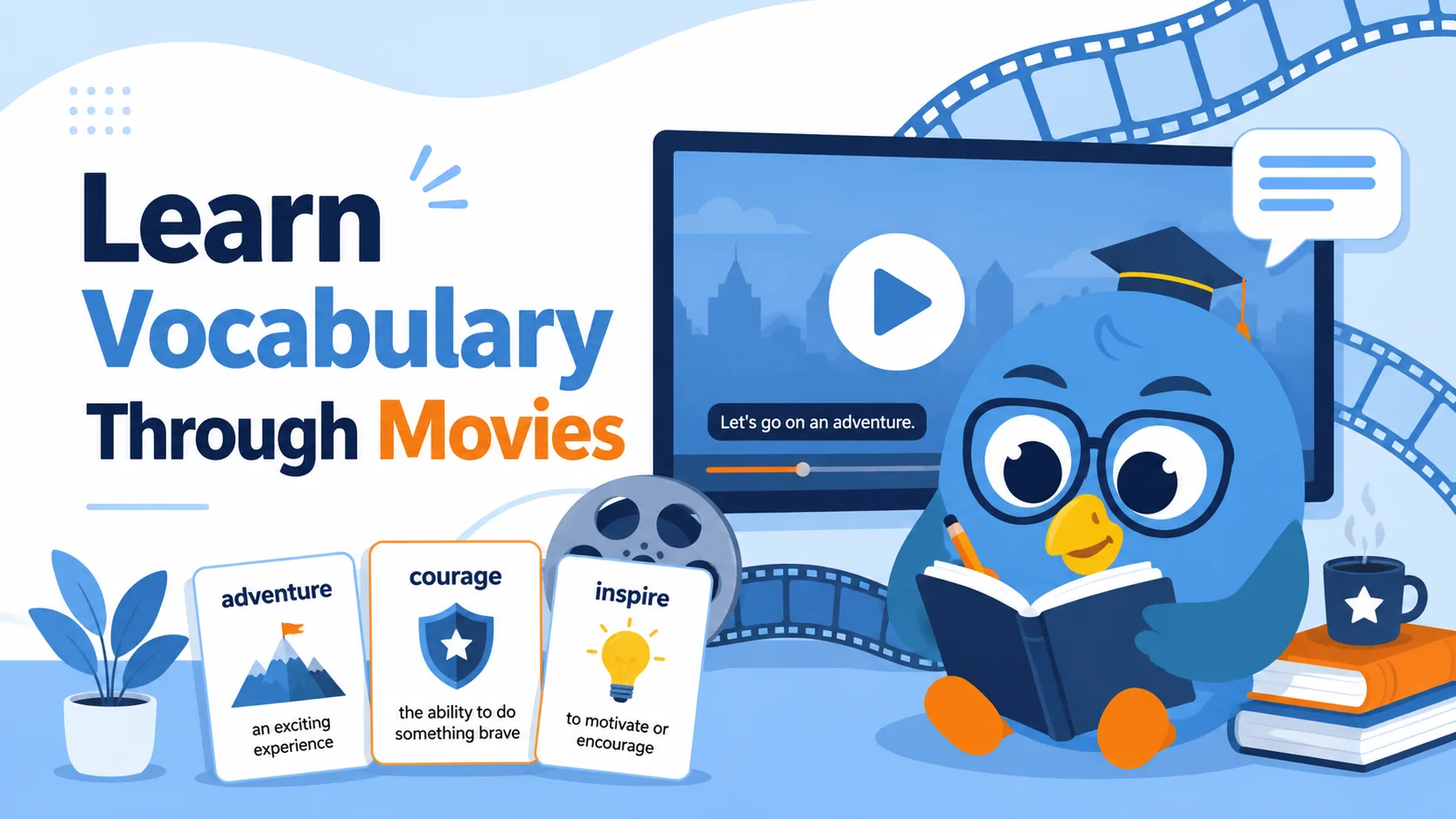
Many students enjoy watching English movies, short videos, or series and believe this is a natural way to learn vocabulary. This is true, but only partially. Watching movies can help learners expose themselves to real English, hear how native speakers talk, and remember words in context. However, if watched passively, learners can easily just "listen for fun" without genuinely learning many new words.
So, does watching movies help you learn vocabulary? The answer is yes, if you know how to turn movie watching into an active learning activity.

1. Movies Help You Learn Words in Context
One of the biggest benefits of learning vocabulary through movies is that you don't learn words in isolation. Instead of just seeing a word in a list and its Vietnamese meaning, you see the word appear in a specific situation: a character is angry, happy, persuading someone, apologizing, or telling a story.
For example, when learning the word “embarrassed”, you don't just know it means “xấu hổ” (ashamed/embarrassed). You can also observe the character's facial expressions, tone of voice, and the situation that makes them feel embarrassed. This makes vocabulary easier to understand and remember.
This is also why video lessons on Parroto can support learners better than just learning words from books. When new words appear in a real context, learners not only understand their meaning but also how to use them.
2. Movies Help You Hear Natural Pronunciation
A common problem when learning vocabulary is that learners recognize the written word but don't recognize it when they hear it. This happens because real English often involves linking sounds, reductions, stress, and intonation. The way a word is read in isolation can differ from how it appears in natural speech.
When watching movies, learners have the opportunity to hear English at a natural speed. You will gradually become accustomed to how native speakers pronounce, emphasize important words, and link sounds in a sentence. This is especially helpful for listening skills.
However, to make listening more effective, you shouldn't just turn on a movie and read Vietnamese subtitles. A better learning method is to choose a short segment, listen carefully, and try to transcribe what you hear. On Parroto, the Dictation feature helps learners practice this skill by listening and typing sentences, thereby paying more attention to each word, sound, and pronunciation in a real context.

3. Movies Help You Learn Natural Phrases
When learning vocabulary, many students often only learn individual words. However, in real communication, native speakers often use fixed phrases or common expressions. For example, they don't just use the word “decision”, but often say “make a decision”. They don't just say “attention”, but use the phrase “pay attention”.
English movies and videos are excellent resources for learning such phrases. You might encounter everyday expressions like “What’s going on?”, “I’m not sure”, “That makes sense”, “It depends”, or “I didn’t mean to do that”. These phrases have much higher applicability than learning difficult but rarely used words.
When you encounter a good phrase, you should save the entire phrase instead of just a single word. If you use Parroto, you can save words or phrases to your vocabulary cards for later review, making your learning more systematic.

4. Movies Create Emotion, Making Words Easier to Remember
One reason why vocabulary in movies is easier to remember is that it's associated with emotions. You might remember a funny line, a touching scene, or a tense dialogue. When vocabulary is linked to images, sounds, and emotions, the brain remembers it better than just seeing words on paper.
For example, if you learn the word “betray” through a scene where a character is betrayed by a best friend, that word will make a much stronger impression. You remember not only the meaning but also the feeling and the situation in which the word is used.
This is the strength of learning through video content. It makes vocabulary less dry and closer to real life.
5. But Passive Movie Watching Is Not Enough
While movies can help with vocabulary learning, many people make a mistake: they watch a lot but don't remember much. The reason is they watch too fast, rely too much on Vietnamese subtitles, and don't review new words after watching.
If you only watch movies for entertainment, you might understand the general content but not truly transform the vocabulary into your own knowledge. To learn effectively, you need to pause at important parts, take notes of new words, re-listen to sample sentences, and try using those words in your own sentences.
Instead of watching a 45-minute episode, you can choose a 2-3 minute segment and study it thoroughly. Re-listen, imitate the speech, save new words, and review multiple times. This method is slower but more effective.
6. Practice Speaking Along to Make New Words Your Own
A vocabulary word is only truly useful when you can use it in communication. After hearing a good sentence in a movie, try to speak along with the character. Pay attention to how they stress words, link sounds, and convey emotions. This is the Shadowing method, which is very effective for practicing vocabulary, pronunciation, and naturalness in speaking.
With Parroto's Shadowing feature, learners can listen to sample sentences, speak along, and practice multiple times. This helps you not only to "know" the word but also to become familiar with how to use it in a sentence. When faced with a similar situation in real life, you'll find it easier to spontaneously use the phrase.
7. Review Vocabulary After Watching
Learning words through movies won't be effective if you don't review them. After watching and saving new words, spend a few minutes each day reviewing those words. You can self-test their meaning, create sentences, or practice quick recall with vocabulary games.
On Parroto, activities like vocabulary cards, vocabulary sprint, and vocabulary arena can make reviewing more fun. Instead of just looking at a word list, learners get to practice quick recall and check if they truly remember the words.
Conclusion
Watching movies can help students learn vocabulary effectively, but only if they learn actively. Movies help learners encounter vocabulary in real contexts, hear natural pronunciation, learn common phrases, and remember better thanks to images, sounds, and emotions.
However, just watching movies is not enough. Learners need to know how to choose short segments, listen carefully, record new words, practice speaking along, and review regularly. When combining video watching with tools like Dictation, Shadowing, vocabulary cards, vocabulary sprint, and vocabulary arena on Parroto, learning words is no longer a dry memorization process, but becomes a natural, interesting, and more effective journey.

