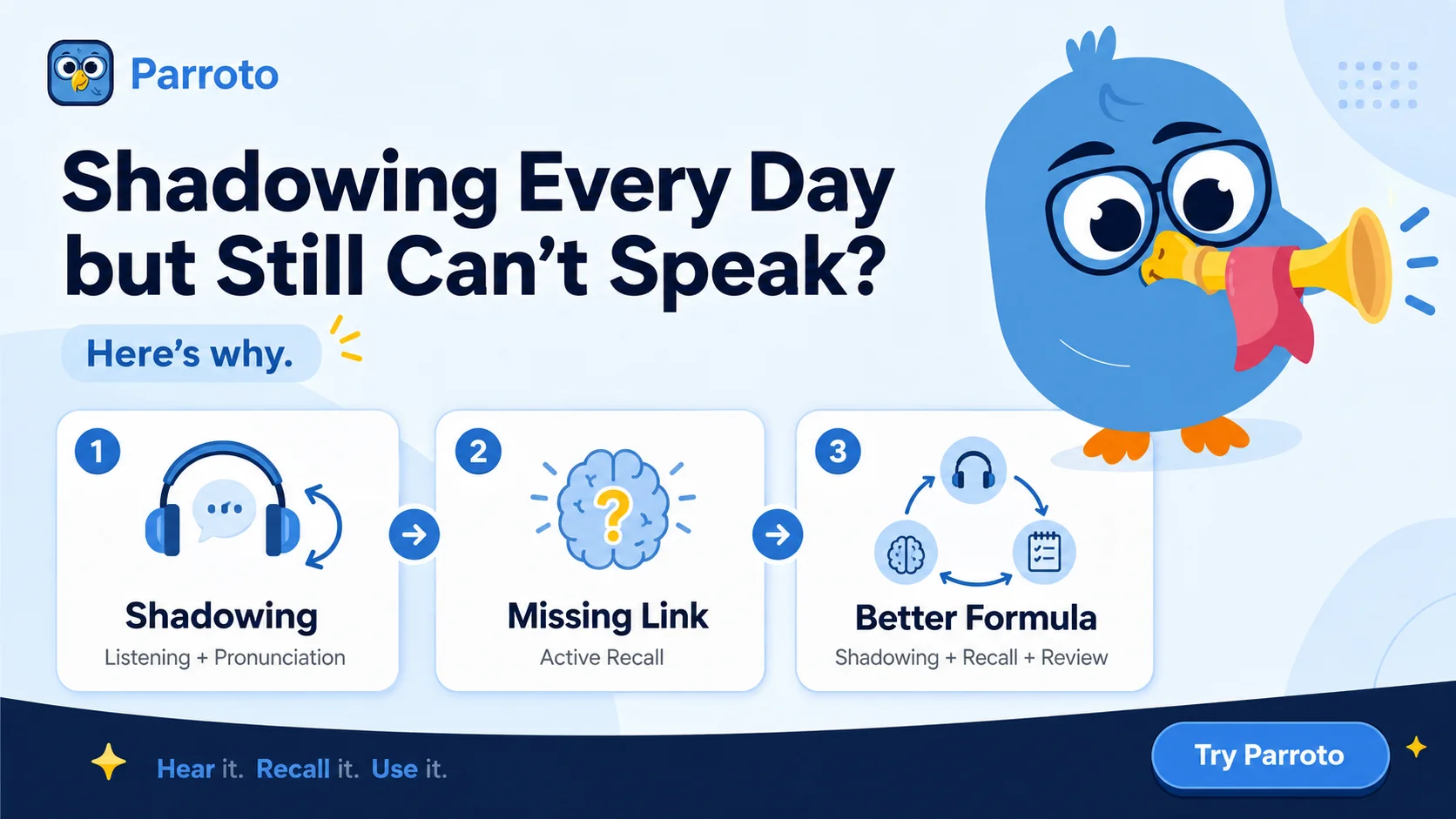
Are You Learning Shadowing the Wrong Way?
Many English learners are familiar with Shadowing. They spend tens of minutes each day listening and mimicking audio, but after a few months, they still don't speak more fluently, their reactions are slow, and their pronunciation hasn't significantly improved.
The problem isn't with the method.
The problem is that most people are misunderstanding the purpose of Shadowing.
Shadowing is not a pronunciation exercise. In fact, it's a method to build real-time language processing ability – a core skill for effective English communication.
What Is Shadowing Really Training?
When we listen to our native language, the brain almost never needs to translate word by word.
Sound comes in, meaning is processed almost instantly, and you respond naturally.
Conversely, when learning English, most learners go through a process like this:
Listen → Separate each word → Translate to Vietnamese → Understand → Think of an answer → Translate back to English → Speak.
This process makes communication always a few seconds slower.
Shadowing forces you to skip the translation step.
When you have to repeat immediately after the speaker, you no longer have enough time to analyze each word. The brain gradually learns to process in chunks of meaning instead of individual words.
That's the greatest value of Shadowing.

How Do Beginners Usually Practice Shadowing?
Most try to:
- Imitate the voice exactly.
- Pronounce every word correctly.
- Listen a lot.
These are all good goals.
But if you stop there, you're just turning Shadowing into... a reading aloud exercise.
You might pronounce better, but when you enter a real conversation, you still take a few seconds to think about what to say.
Effective Shadowing Is When Your Brain Starts to Predict
Observe native speakers during conversations.
They don't wait for the other person to finish speaking before they start processing.
The brain constantly predicts the next word, the next structure, and the next idea.
This is also what happens when you Shadow correctly.
For example, after hearing:
I'm looking forward...
Your brain has almost certainly predicted:
- to seeing you
- to hearing from you
- to meeting everyone
Instead of just repeating sounds, you are learning to predict language.

This ability helps you listen faster, understand better, and react more naturally.
Why Does Shadowing Also Improve Listening Skills?
Many people think Shadowing is a speaking exercise.
In reality, it's also one of the most effective active listening exercises.
When just listening to a podcast, if you miss a few words, you can still continue.
But when Shadowing, if you lose track of even one sound, you will immediately fall behind.
This forces the brain to:
- focus more,
- recognize linked sounds faster,
- process natural speech speed better,
- maintain continuous attention.
That's why many people notice significant improvement in their listening skills after practicing Shadowing for a while.
Shadowing Isn't Always Suitable
A common mistake is choosing audio that is too difficult.
If you only understand about 40–50% of the content, Shadowing will hardly be very effective.

The brain will spend all its energy trying to guess vocabulary instead of building language processing ability.
The ideal level is when you understand about 80–90% of the content before starting Shadowing.
At that point, you're no longer learning new words, but practicing English processing speed.
How to Make Shadowing More Effective?
Instead of listening to a segment repeatedly and mimicking, divide it into three steps.
Step 1: Listen and understand the entire content.
Step 2: Shadow multiple times until you can keep up with the speaker's speed.
Step 3: Turn off the audio and rephrase in your own words.
By the final step, you're no longer imitating.
You begin to produce language, and that is the ultimate goal of learning to speak.
Shadowing or Dictation: Which Method Should You Choose?
These are not two competing methods.
They complement each other.
Dictation helps you hear every sound, every word precisely, recognize linked sounds, reductions, and common mistakes you often miss.
After hearing correctly, Shadowing helps you turn what you just heard into natural speaking reflexes.
Think of it simply:
- Dictation helps you "hear clearly."
- Shadowing helps you "speak smoothly."

Combining both creates a complete learning cycle: Hear correctly → Understand correctly → Mimic correctly → Speak naturally.
Conclusion
When practiced correctly, you will not only improve your pronunciation but also increase your listening comprehension speed, communication reflexes, and ability to use English more naturally.
Want to combine Dictation and Shadowing in the same learning path? On Parroto, you can practice listening with Dictation to catch every sound, then switch to Shadowing directly on the same lesson. This is how thousands of learners improve both listening and speaking skills simultaneously without memorizing every rule.