
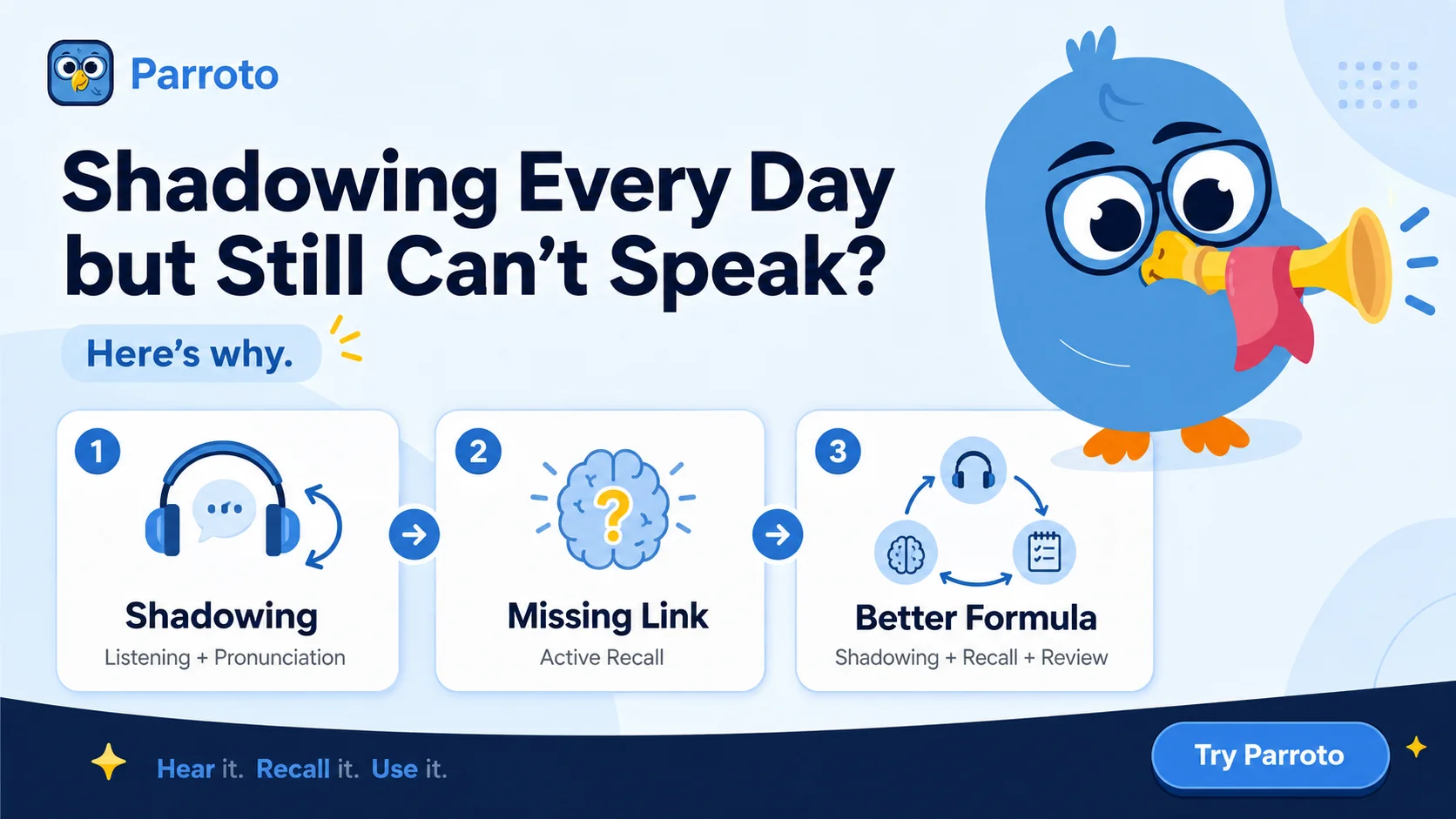
Shadowing Every Day But Still Can't Speak English? This Might Be Why
It's a paradox many English learners have experienced. They spend dozens of minutes every day listening and repeating after videos, podcasts, or sample conversations. They might mimic native-like intonation quite well, and their pronunciation significantly improves from before. Yet, when stepping into a real conversation, they still hesitate, take a long time to think, and don't know how to express their ideas. This leads many to ask: if shadowing is an effective method, why can't I communicate naturally yet?
The truth is, the problem isn't that you haven't practiced shadowing diligently enough. The issue lies in many people expecting shadowing to solve a task for which the method itself wasn't designed. Shadowing is a powerful tool to improve listening comprehension and pronunciation, but it's not the entire picture of learning to speak English.
What Does Shadowing Actually Help You Improve?
First, it's important to understand that shadowing is one of the language learning methods widely used by foreign language learners and even professional interpreters. When shadowing, you listen to a sentence and try to repeat it almost simultaneously with the speaker. This process forces the brain to process sounds, identify words, and control the mouth muscles to produce corresponding sounds in a very short time.
As a result, shadowing helps learners become familiar with the natural rhythm of English, improving their ability to recognize connected speech, reduced sounds, and pronunciation features commonly found in real-life communication. This is why many feel their listening skills improve significantly after consistent practice. Sounds that once seemed vague start to become more familiar, and the processing speed for English noticeably improves.
Additionally, shadowing helps build auditory memory of the language. When you listen to and repeat the same sentence pattern multiple times, your brain starts to remember how that sentence is naturally pronounced. This is particularly useful for those who frequently struggle with pronunciation or intonation.
However, all these benefits are only a part of communication ability.
Why You Still Can't Speak English Fluently
Imagine you've just watched a movie and remember the character's lines very clearly. If someone plays that movie segment again, you can easily recognize what the next line is. But if you're asked to retell the entire movie plot in your own words, that task becomes much more difficult.
This is the difference between two crucial cognitive processes in language learning: recognition and recall.
When shadowing, you are primarily performing a recognition task. You hear an existing language pattern and reproduce it. The brain is provided with immediate input, making repetition relatively easy. In contrast, real-life communication requires recall. You have to find vocabulary yourself, arrange ideas, choose sentence structures, and generate language without any external cues.

That's why many people can understand English quite well but still can't communicate naturally. They've spent a lot of time recognizing English but not enough time actively producing English.
In other words, shadowing helps you learn how to mimic language, while communication requires you to own the language.
Common Mistakes When Practicing Shadowing
One of the biggest mistakes is treating shadowing as the ultimate goal. Many people open a video, repeat after the speaker for 20 or 30 minutes, and then end their study session. They feel they've practiced diligently, but in reality, they haven't given their brain the opportunity to use what they've just learned.
Think about how we learn to drive. Observing others drive can help you understand the process, but it cannot replace actually holding the steering wheel yourself. Similarly, repeating an English sentence doesn't mean you can use that sentence in a completely new conversation.
Another mistake is focusing solely on pronunciation while ignoring meaning. In such cases, shadowing becomes merely an exercise in mimicking sounds. Learners might sound very similar but don't truly understand how to use structures or phrases in different contexts.
What's Missing: Active Recall
If shadowing is the step that helps you receive language, then active recall is the step that helps you transform that language into your own skill.
Active recall is the process of actively retrieving information from memory rather than just recognizing it. This is one of the most researched learning techniques in cognitive science and has been proven to significantly improve long-term retention.
In English learning, active recall can be as simple as closing the transcript after shadowing and trying to retell the content in your own words. You can also try to answer questions related to the topic you just studied or use new vocabulary to create completely different sentences.
Initially, this process will be quite challenging. You'll forget words, make mistakes, and speak slower than desired. But it is precisely in these moments that the brain truly learns how to use the language. The feeling of "struggling" to recall a word or a sentence structure is actually a signal that memory is being strengthened.
A More Effective Formula: Shadowing + Recall + Spaced Repetition
English learners who make rapid progress often don't stop at shadowing. They combine shadowing with activities that force the brain to recall information and review it after a certain period.

For example, after shadowing a conversation about personal hobbies, instead of moving on to a new lesson immediately, they will try to answer similar questions using their own experiences. A sentence like “I enjoy hiking because it helps me relax” can become a starting point for learners to talk about activities they genuinely love. This process of personalizing the language helps knowledge transition from short-term memory to practical usability.
When those vocabulary and sentence patterns are revisited with flashcards or appear in other lessons a few days later, the brain reinforces them once more. This is why those who study less but study correctly often make faster progress than those who spend many hours just listening and repeating.
How to Practice Shadowing More Effectively?
An effective study session doesn't necessarily have to last for hours. You can spend a few minutes shadowing a short conversation to get familiar with native pronunciation and rhythm. Afterward, try to retell the content in your own words without looking at the transcript. Finally, answer a few questions related to the topic or review the new words that appeared.
This combination helps you practice three important skills simultaneously: listening comprehension, pronunciation, and language retrieval ability. Over time, you'll notice that you not only sound more like a native speaker but also respond faster in communication.
From Repeating English to Using English
Shadowing is an excellent method and certainly deserves a place in any learner's study plan who wants to improve their speaking and listening skills. However, if your goal is fluent communication, shadowing shouldn't be the endpoint. It should be the starting point for a series of activities that help the brain transition from recognizing language to using language.
Many learners think their problem is not practicing enough. In reality, sometimes the problem lies in missing a crucial link. By combining shadowing with active recall activities and scientific review, you not only learn to repeat English but also learn to turn English into a tool to express your own thoughts. And that is the ultimate goal of learning a language.
Try the shadowing + dictation duo with a detailed AI scoring system ABSOLUTELY FREE at parroto.app today. The app is now available on the website, Android, and iOS!

