
Effective Ways to Learn English Vocabulary, Remember Long-Term, and Use Fluently
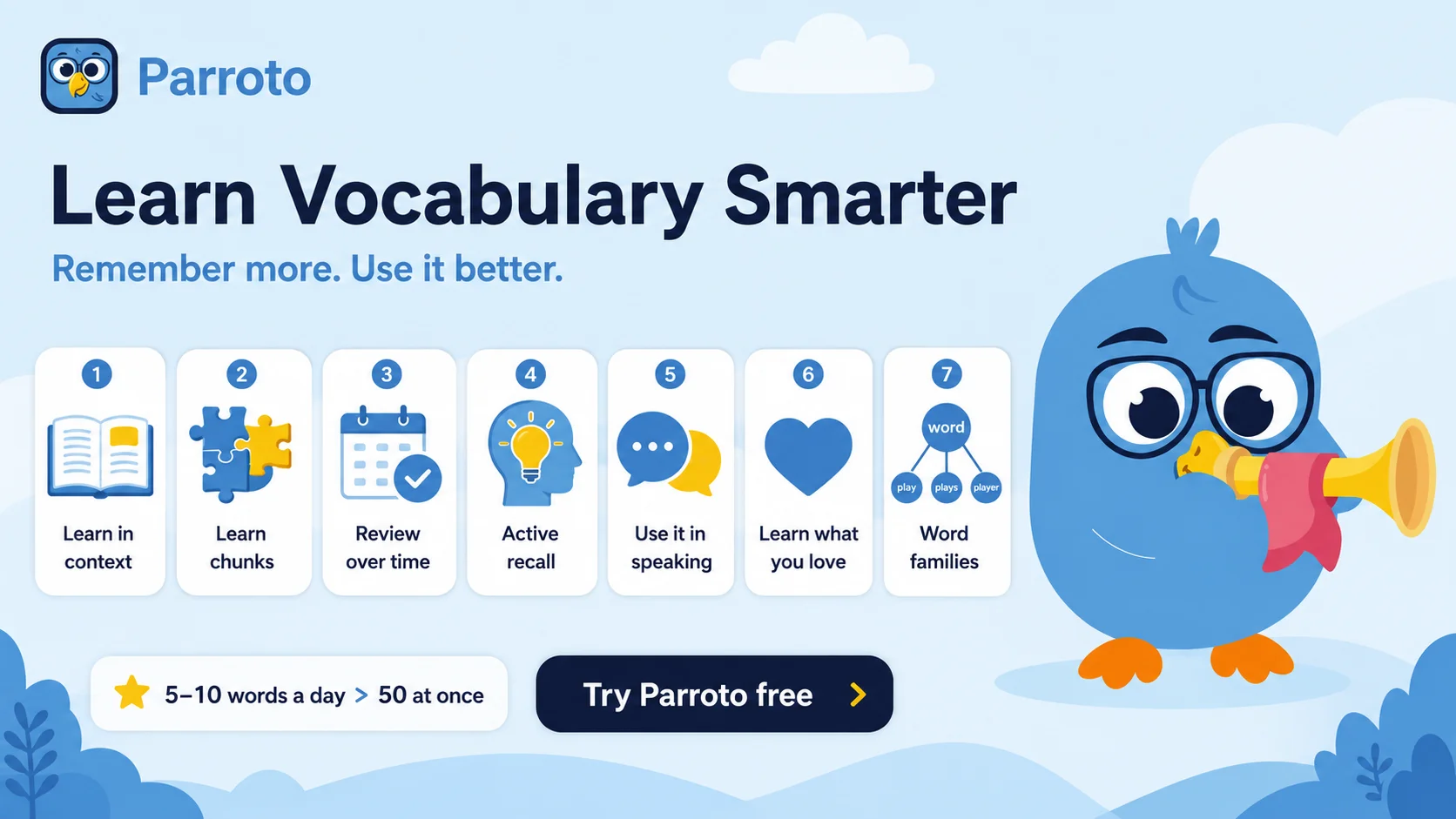
Learning 50 words in one session, then forgetting most of them a few days later—and even the ones you remember don't come to mind when you need to speak. The problem isn't that you're not learning enough, but that you're learning the wrong way. Vocabulary is remembered longer and can be used when you learn it in context, in chunks, and actively use it—not when you cram a list of isolated words. Below are 7 principles to help you do just that.
Why learning isolated words often fails
When you learn words like "apple = quả táo", your brain only stores a weak link between the two words. There's no image, no sentence, no emotion associated with it—so it's hard to retrieve when needed. Researchers call this the problem of depth of processing: the deeper you process a word (associating it with context, examples, experiences), the longer you'll remember it. Learning dry lists is the most superficial way of processing, and thus the easiest to forget.
Just by changing your learning method, the same amount of time will yield completely different results.
Learn words in context, not in isolation
A word often has many meanings and nuances—only context tells you how to use it. Instead of learning "run = chạy", encounter it in a sentence: "She runs a small café" (operates), "My nose is running" (flowing). When you learn a word in a real sentence, you remember its usage along with its meaning.
Tip: For each new word, record a real example sentence where you encountered it, instead of just its Vietnamese meaning.
Learn in chunks (collocations), not individual words
Native speakers don't combine words randomly—they speak in familiar chunks. You say "make a decision" rather than "do a decision"; "heavy rain" rather than "strong rain". Learning collocations helps you speak more naturally and faster, as you retrieve entire phrases instead of assembling individual words.
Spaced repetition instead of cramming
Memory fades quickly in the first few days after learning. The way to combat this is to re-encounter words at gradually increasing intervals—today, tomorrow, a few days later, a week later. This is spaced repetition, and it's much more effective than reviewing once for a long time and then stopping. (We've discussed this mechanism in depth in the articles "Streaks" and "Vocabulary Arena".)
Tip: Learning fewer words daily but consistently (5–10 words) is more effective than 50 words at once and then quitting.
Actively recall, don't just reread
Cover the meaning and try to recall the word yourself (active recall): look at the Vietnamese, say the English word; or look at the word, create a sentence. Each time you retrieve a word from memory, you engrave it deeper.
Use words when speaking and writing
There are two types of vocabulary: passive (understood when encountered) and active (can be used by yourself). The goal is to move words from passive to active, and the only way is to use them. After learning a new word, create 1–2 of your own sentences, or use it in a short speech about your life. Words you've used to talk about yourself will be remembered for a very long time.
Learn from content you genuinely enjoy
You'll naturally re-encounter vocabulary many times if the content is engaging enough to keep you coming back. Movies, songs, podcasts, videos about your hobbies—these are "live" sources of vocabulary, accompanied by context, emotion, and real pronunciation. Listening repeatedly to a segment you like will teach you more natural phrases than a page of vocabulary words.
Expand by word families
From a root word, you can quickly generate and learn many related words:
decide (v) → decision (n) → decisive (adj) → decisively (adv)
Learning by word families helps you not only increase your vocabulary but also understand how word types transform—very useful when writing and speaking.
A 10-minute daily vocabulary learning routine
- Encounter words in context—pick 5 new words/phrases from a video or article you enjoy.
- Record them correctly—each word with 1 real example sentence + pronunciation.
- Actively recall—cover the meaning, say the word; cover the word, create a sentence.
- Use immediately—speak a short paragraph about your day, try to incorporate a few new words.
- Review—re-encounter old words the next day and a few days thereafter.
How many words should I learn per day?
- Around 5–10 words/phrases daily, learned consistently and reviewed, is far more effective than learning dozens of words at once and then quitting.
- How to remember vocabulary long-term?
- Learn words in context, use spaced repetition, actively recall instead of rereading, and use words in your own speaking/writing.
- Should I learn single words or collocations?
- Prioritize learning collocations like "make a decision", "heavy rain"—this helps you speak more naturally and correctly than combining individual words.
Conclusion
Effective vocabulary learning isn't about learning more words, but about learning the right words, in chunks, in context, and then using them repeatedly. When each new word is associated with a real sentence and actively used by you, long-term memory will come naturally—and more importantly, you'll be able to use them when speaking.
If you want to learn vocabulary directly from real video contexts, look up words instantly, and review at the right time, you can try it for free at parroto.app.


