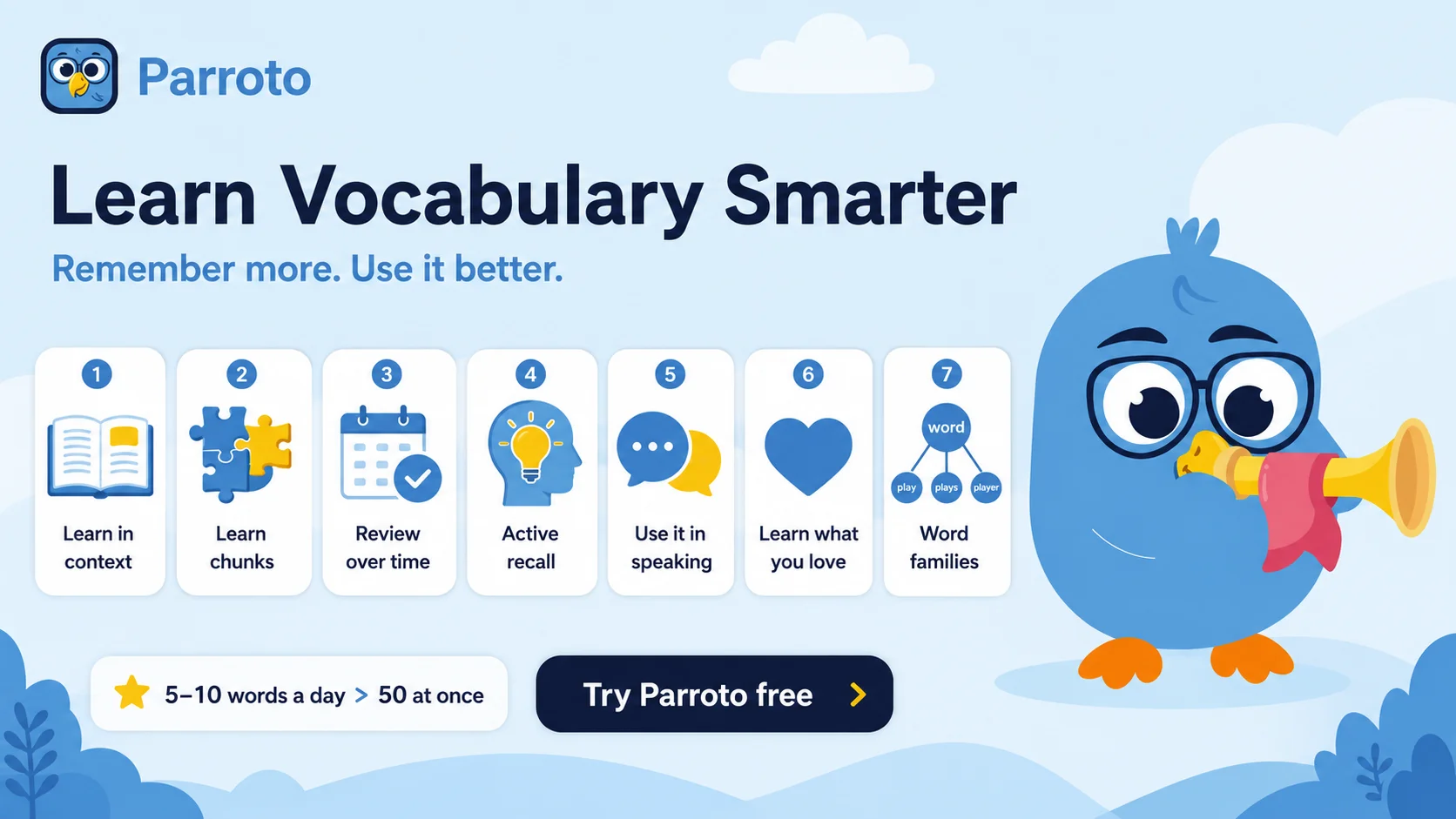
How to Create Truly Effective Vocabulary Flashcards
Flashcards are one of the most popular vocabulary learning tools. Many English learners use vocabulary flashcards to memorize new words, review before exams, or expand their vocabulary daily. However, not everyone who uses flashcards learns effectively. Some create many cards but quickly forget. Others can recognize a word and its meaning but cannot use it when speaking or writing.
The problem isn't with flashcards themselves, but with how you create and use them. A good vocabulary flashcard not only helps you remember the meaning of a word but also helps you understand how to use that word in a real context.
1. Don't Just Write the Word and its Vietnamese Meaning
The most common way to make flashcards is to write the English word on one side and its Vietnamese meaning on the other. For example:
Front: improve
Back: cải thiện
This method is simple, but not enough. When you only learn the Vietnamese meaning, you might remember the word for a short time but still not know how to use it in a sentence. You also tend to understand words mechanically.
Instead of just writing the meaning, add a short example sentence. For example:
Front: improve
Back: to become better
Example: I want to improve my English speaking skills.
Example sentences help you see how the word is used. This way, you don't just remember the meaning but also the structure and context of use.

2. Learn Phrases, Not Just Single Words
A big mistake when making flashcards is only saving individual words. In English, vocabulary often comes in chunks. If you only learn the word “decision”, you might know it means “quyết định” (decision), but you might still misuse it by saying “do a decision”. The correct phrasing is “make a decision”.
Therefore, instead of creating cards for single words, create cards for entire phrases. For example:
- make a decision
- pay attention
- make progress
- take responsibility
- stay motivated
This learning method helps you speak and write more naturally. When using Parroto, if you encounter a good phrase in a video or lesson, you should save the entire phrase to your vocabulary flashcards instead of just a single word.
3. Choose Words You Truly Need to Learn
Not every new word should be turned into a flashcard. If you save too many words, your flashcard deck will become overwhelming, and you'll quickly get bored when reviewing. An effective flashcard deck requires selection.
You should save words that:
- Appear frequently
- Match your proficiency level
- Can be used in speaking or writing
- Are relevant to your learning goals
- Are related to a topic you are currently studying
For example, if you're studying the topic of education, phrases like “study routine”, “make progress”, “stay focused”, or “review regularly” will be more useful than words that are too rare or too academic.
On Parroto, learners can save words directly from the learning content, making their flashcard deck more personalized. You learn words from your actual lessons, not from a random list.
4. Add Context to Each Card
A good flashcard should answer the question: “In what situation is this word used?” If you only write the meaning, you'll easily forget. But if you associate the word with a story, an image, or a specific situation, the word will be much easier to remember.
For example, with the word “nervous”, instead of just writing “lo lắng” (anxious), you can write:
I feel nervous before a speaking test.
This sentence helps you connect the word with a familiar situation. When you encounter a similar situation in real life, you'll remember and use the word more easily.
If you're learning through videos on Parroto, you can utilize the exact sentences from the lesson as examples. This is a great way because you've already heard the word in a real context, not just learning a disconnected sentence.

5. Add Pronunciation or Listen to the Word Again
Many people learning with flashcards only focus on the written form. This means they can recognize words when reading but not when listening. Therefore, an effective vocabulary flashcard should include pronunciation or at least an activity to listen to the word in a sentence.
When learning a new word, pay attention to:
- Where the word's stress is located
- If the final sounds are clearly pronounced
- How the word sounds in a complete sentence
- If there are linking or elision phenomena
This is where features like Dictation and Shadowing on Parroto can support better flashcard learning. You don't just save words to cards; you also listen again, type them out, and speak along with sentences containing those words. As a result, vocabulary doesn't just stay on the screen but also integrates into your listening and speaking skills.
6. Review Cards in Various Ways
If you always look at the English word and guess the Vietnamese meaning, you are only practicing in one direction. To remember words more deeply, review flashcards in several ways:
- Look at the English word and recall its meaning.
- Look at the Vietnamese meaning and recall the English word.
- Look at the example sentence and guess the missing word.
- Create a new sentence with that word yourself.
- Say the example sentence aloud instead of just reading silently.
This review method helps you not only recognize words but also gain the ability to use them. The ultimate goal of vocabulary learning is not just “knowing when you see it,” but “being able to retrieve it when you need to use it.”
7. Review Little but Regularly
Flashcards are only effective if you review them frequently. If you create many cards but never look at them again, they won't be very helpful. Instead of studying 50 cards in one day and then forgetting them, review a small amount daily.
You can dedicate 5 to 10 minutes each day to reviewing cards. Each time you review, focus on words you're about to forget or words you haven't been able to use yet. Regular repetition helps vocabulary gradually transfer from short-term to long-term memory.
With Parroto, learners can combine vocabulary flashcards with activities like “vocabulary shooting” or “vocabulary arena” to make reviewing less tedious. When reviewing words includes elements of quick reaction and challenge, you'll find it easier to maintain the habit.
Conclusion
Flashcards are a highly effective vocabulary learning tool, but only when used correctly. Don't just write the word and its Vietnamese meaning. Learn entire phrases, add example sentences, choose highly applicable words, pay attention to pronunciation, and review regularly.
With Parroto, learners can create vocabulary flashcards directly from the content they are studying, then combine them with Dictation, Shadowing, vocabulary shooting, and vocabulary arena to remember better. When flashcards are combined with listening, speaking, and active review, vocabulary learning becomes more practical, enjoyable, and effective every day.